
Triaxial Cells
- home
- Civil Engineering
- Soil testing equipment
- Triaxial Cells
Triaxial Cells
Short Discription :
The triaxial shear strength test is a widely used method to determine the mechanical properties of soil and rock samples. This test applies stress in different directions, allowing for the measurement of properties such as shear resistance, cohesion, and dilatancy stress. It involves subjecting a cylindrical core specimen to confining pressures on all sides to evaluate its shear strength.
Standard Following :
IS 2720 (Part 11) and (Part 12)
Brochure:
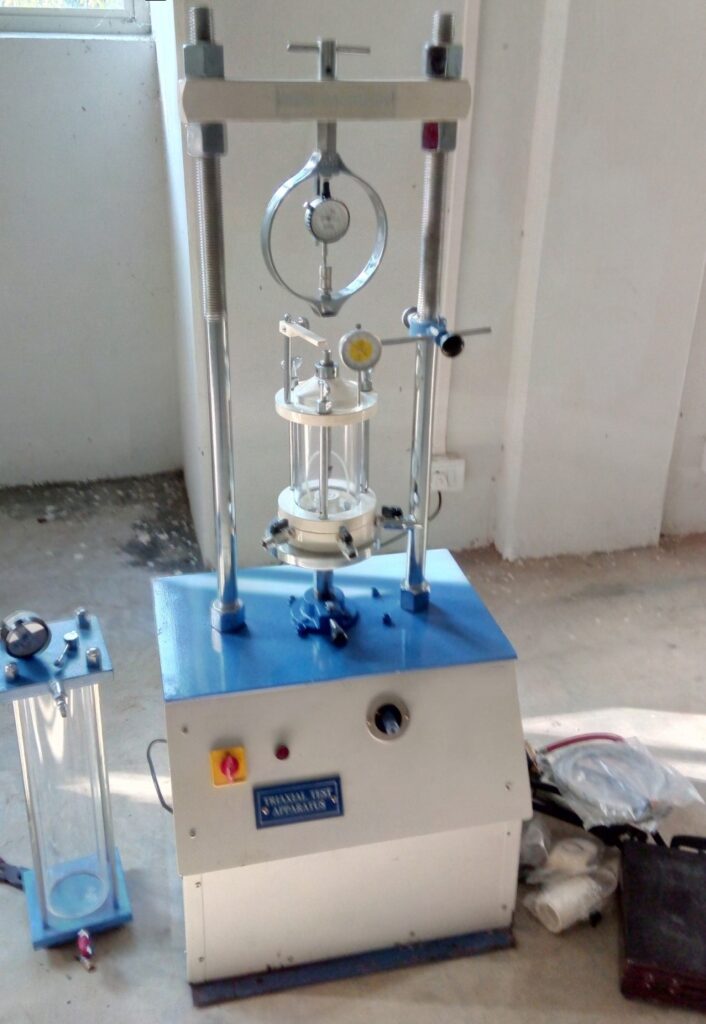
DESCRIPTION
FEATURES
VIDEO
DESCRIPTION
| BE 11-01 | Manual type Load frame |
| BE 11-02 | Digital type with Software |
| BE 11-03 | Perspex loading pads (38 mm and 50 mm dia.) |
| BE 11-04 | Pair of plain Perspex discs (38 mm and 50 mm dia. × 6 mm thick) |
| BE 11-05 | Porous stones (38 mm and 50 mm dia. × 6 mm thick) for drainage |
| BE 11-06 | Split sand former and sheath stretcher for sample preparation (38 mm and 50 mm) |
| BE 11-07 | Pore Pressure Apparatus: Includes a null indicator, mercury manometer, and volume change burette |
| BE 11-08 | Proving Ring 50 kn |
| BE 11-09 | Dial Gauge 25 mm |
| BE 11-10 | Load Cell 50 kn |
| BE 11-11 | LVDT 25 mm |
| BE 11-12 | Constant Pressure System: Air or oil-based for maintaining confining pressure (up to 10 bar) |
| BE 11-13 | Foot Pump |
| BE 11-14 | Water Tank Assembly |
FEATURES
Nothing To Show
VIDEO
Nothing To Show